Match the load.
Compare the combined running load with the listed 1,000 W output. Check startup demand separately; a watt-hour figure cannot answer either question.
NFA 8655 / OFF-GRID POWER
Stored energy for compatible devices connected directly to the unit. NFA 8655 combines a LiFePO₄ battery, AC output and solar input in a standalone off-grid system.
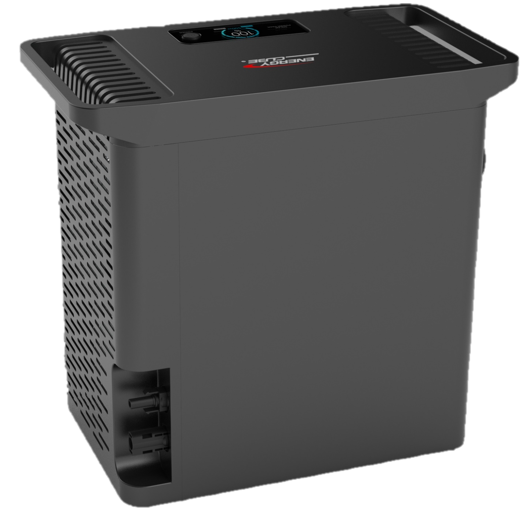
A DIFFERENT JOB FROM HOME SOLAR STORAGE
For equipment you intend to connect directly to a power unit, the important questions are practical: how much it draws, what it needs when starting, which voltage it uses and how long you need it to run.
8655 is the off-grid model in the NFA range. If your goal is a grid-connected solar-storage installation for the home, explore NFA 8657 instead ↗
Compare the combined running load with the listed 1,000 W output. Check startup demand separately; a watt-hour figure cannot answer either question.
The supplier lists 220–240 V and 110–120 V variants. Specify your market, voltage and equipment connections before choosing a unit.
The workbook lists a 600 W solar input and 1,000 W charging power. Ask for the exact voltage/current limits and charging instructions for the supplied variant.
8655 / SUPPLIER SPECIFICATIONS
Watt-hours describe the battery’s listed energy capacity. Watts describe power. Neither the 2,000 Wh capacity nor the 1,000 W output guarantees a particular appliance runtime.
Source: original supplier workbook, Sheet1 column B, rows 4–14. These are supplier-listed figures, not independent test results. Exact usable energy, surge rating, dimensions and weight are not established here.
| Model / type | 8655 / off-grid |
|---|---|
| Battery capacity | 2,000 Wh |
| Battery chemistry | LiFePO₄ |
| Output power | 1,000 W |
| Charging power | 1,000 W |
| Solar input | 600 W |
| Voltage variants | 220–240 V / 110–120 V |
| Display | LCD |
BEFORE YOU CHOOSE
8655 is listed as off-grid. This page describes equipment connected directly to the unit, not a home grid-feed arrangement. Do not connect an output to household wiring without a specifically approved system and qualified electrical review.
That needs the appliance’s continuous and startup demand, voltage, connection and the exact product limits. Use the equipment brief below to collect those details. We do not infer compatibility from an appliance name alone.
The workbook describes a two-master parallel arrangement, with listed combined figures of 2,000 W and 4,000 Wh. Treat that as a supplier-described configuration, not permission to connect units yourself. Obtain the approved accessories and model-matched instructions.
A current retail quotation and final kit contents are not published here. Ask for the exact voltage variant, included cables/accessories, delivery, warranty and total price together.
The supplied workbook identifies the model and ratings. A complete manual explicitly identifying 8655 still needs confirmation. The separate PowerHelp-Mini manual is not presented as an 8655 manual without that link.
NFA 8655 / YOUR NEXT STEP
List what you want to power. Get a first check against the supplier’s output rating and a practical checklist to take to your supplier.
NFA 8655 / EQUIPMENT BRIEF
Describe your application, market, supply voltage, equipment and whether startup demand is known.
An equipment brief, not an electrical design or runtime guarantee. Your details stay in this page; downloading or copying does not submit them.